


Inductively Coupled Plasma-Optical Emission Spectrometry (ICP-OES)
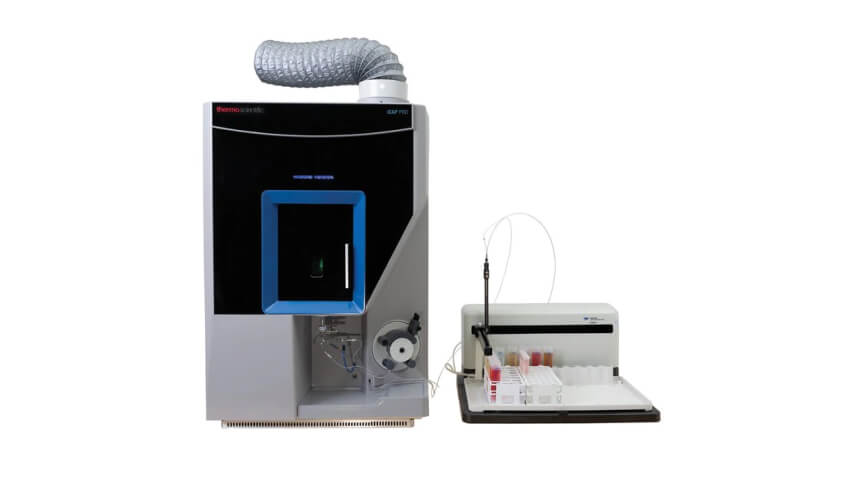
iCAP PRO XPS ICP-OES

iCAP PRO XP ICP-OES

iCAP PRO ICP-OES and iCAP PRO X ICP-OES

FAQ - Inductively Coupled Plasma-Optical Emission Spectrometry (ICP-OES)
ICP-OES uses high-temperature inductively coupled plasma to excite atoms and ions in a sample. These excited species emit light at characteristic wavelengths, and the emission intensity is used to determine elemental concentrations. The technique enables rapid multi-element analysis.
Axial viewing measures emission along the plasma axis, providing higher sensitivity for many elements. Radial viewing offers more robust analysis of samples with higher concentrations and challenging matrices. Dual View instruments combine both approaches to expand analytical capabilities.
ICP-OES is used to analyze water, soil, food, fertilizers, pharmaceutical products, chemicals, and industrial materials. Samples are typically introduced as solutions, while solid materials generally require dissolution or digestion. The technique is especially suitable for laboratories handling diverse sample types.
Dual View technology enables both axial and radial plasma observation within one instrument. This allows laboratories to optimize sensitivity and analytical robustness according to elemental concentrations and sample matrix composition. Specific capabilities depend on the instrument design and model.
High concentrations of salts, acids, and other matrix components can affect aerosol transport, plasma stability, and emission intensity. These effects can be reduced through appropriate dilution, internal standards, optimized instrument conditions, and matrix-matched calibration.
Spectral interferences occur when emission lines of different elements overlap or background emission affects the measurement. Their impact can be minimized by selecting appropriate analytical wavelengths, applying background correction, and using spectral processing algorithms.
The nebulizer converts a liquid sample into an aerosol, while the spray chamber removes larger droplets and directs suitable aerosol fractions toward the plasma. Component selection affects sensitivity, signal stability, and the system’s tolerance to complex sample matrices.
Simultaneous ICP-OES analysis allows multiple elements to be measured during a single sample introduction, reducing analysis time and sample consumption. This is particularly useful for laboratories processing large sample batches and monitoring multiple analytical parameters.
When choosing among Thermo Scientific™ iCAP PRO™, PRO X, PRO XP, and PRO XPS systems, laboratories should consider detection limits, matrix complexity, sample throughput, and analysis speed. Optical system configuration, plasma viewing options, and automation capabilities are also important. Final selection should match the laboratory’s analytical methods.
Autosamplers enable larger sample batches to be processed with less manual handling. They can automate analysis sequences, system rinsing, and quality control measurements, improving productivity and reducing operator errors. They are particularly valuable in routine analytical laboratories.