


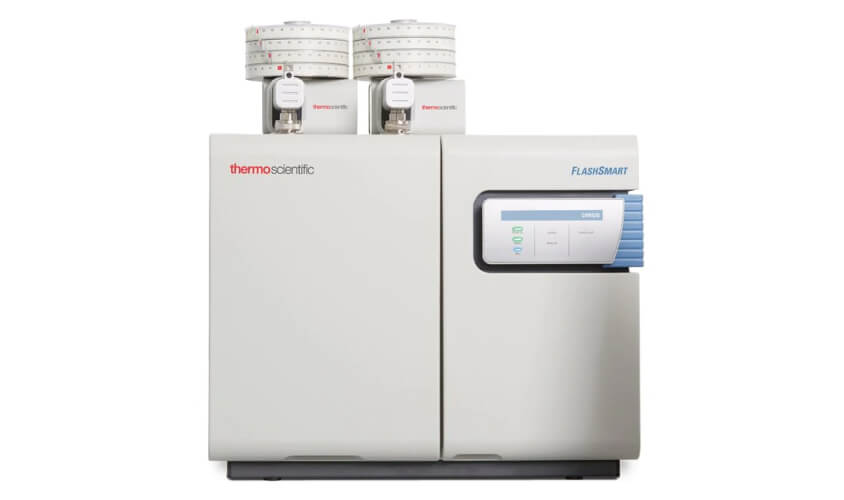
EA IsoLink IRMS System

FlashSmart Elemental Analyzer

FAQ - Organic Elemental Analysis (OEA)
CHNS/O analyzers use controlled sample combustion or pyrolysis to convert chemical elements into gaseous products, which are then separated and detected. These processes enable quantitative determination of carbon, hydrogen, nitrogen, sulfur, and oxygen, depending on the instrument configuration.
CHNS/O analyzers are used for organic compounds, pharmaceutical substances, food, polymers, biomass, fuels, soil, and other suitable materials. Depending on the instrument and analytical method, both solid and liquid samples can be analyzed.
CHNS analysis is typically based on sample combustion in an oxygen-rich atmosphere, followed by determination of the resulting gases. Oxygen is usually measured through a separate pyrolysis procedure under suitable conditions. Therefore, oxygen determination may require a dedicated configuration or different operating conditions.
In the pharmaceutical industry, CHNS/O analysis is used to verify the elemental composition of organic compounds and characterize active pharmaceutical ingredients. Measured results can be compared with theoretical elemental mass percentages to assess consistency with the expected chemical formula.
Yes, total nitrogen content measured by elemental analysis can be used to estimate protein content using an appropriate conversion factor. This principle is applied in various food and animal feed quality control methods. It is important to note that total nitrogen includes non-protein nitrogen.
The required sample mass depends on chemical composition, expected elemental content, and analyzer configuration. Many applications use sample quantities of a few milligrams, while some methods require larger or smaller amounts. Accurate weighing and sample homogeneity are essential for reproducible results.
A thermal conductivity detector (TCD) measures changes in the thermal conductivity of gases passing through the detector relative to a reference gas. In suitable CHNS/O analyzer configurations, it is used to quantify separated gaseous products generated during sample analysis.
Accurate results require a homogeneous sample, precise weighing, complete combustion or suitable pyrolysis, and proper calibration. Reference materials with known compositions and quality control samples are used to monitor instrument stability and analytical performance.
Yes, suitable elemental analyzers can be coupled with isotope ratio mass spectrometers (IRMS). These systems combine elemental analysis with stable isotope ratio measurements, for example of carbon, nitrogen, and sulfur, depending on the configuration and analytical method.
Automated sampling enables sample batches to be analyzed without continuous operator supervision, improving laboratory productivity. Consistent analytical procedures, automated data processing, and controlled sample sequences support more efficient workflows, especially in routine laboratories.