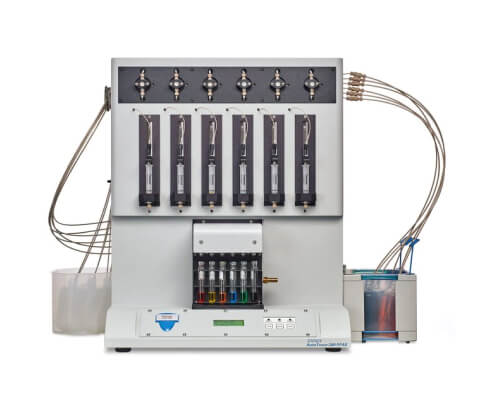
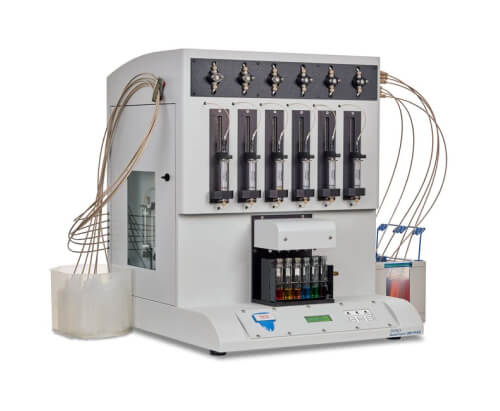
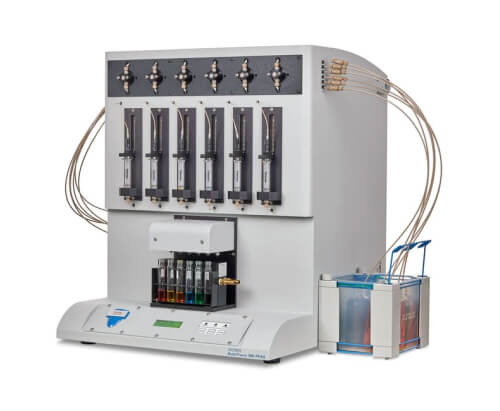
The Thermo Scientific™ Dionex AutoTrace 280™ Solid-Phase Extraction (SPE) Instrument is designed for an easy and efficient extraction of analytes of interest from large volume aqueous samples. The Thermo Scientific™ AutoTrace™ 280 automates all four steps of SPE (conditioning, loading, rinsing, and eluting), thereby reducing solvent consumption and improving both recovery and reproducibility. Boost productivity and reduce cost of analysis by simultaneously processing up to six samples in 2-3 hours with only 15 minutes of operator involvement. In addition, the Thermo Scientific™ AutoTrace™ 280 meets requirements in US EPA methods including the 500 and 600 series.
Sample Preparation for Water Analysis (SPE)
SKU: 9848

Available in countries :
Models
PFAS model
The Thermo Scientific™ Dionex AutoTrace 280™ PFAS (per- and polyfluoroalkyl substances) performs automated solid phase extraction (SPE) for PFAS sample preparation, thereby reducing the risk of background contamination by using non-fluoropolymer-based tubing, valves, and filters. This instrument removes potential interferences from the analysis, while improving extraction recovery and reproducibility with precise flow-rate control. Throughput is increased by processing six samples at a time with minimal user engagement. Thermo Scientific™ AutoTrace™ 280 PFAS ensures compliance with regulated methods such as U.S. EPA 537, 537.1 and 533.
What is the Thermo Scientific™ Dionex AutoTrace 280™ and what is it used for?
The Thermo Scientific™ Dionex AutoTrace 280™ is an automated Solid Phase Extraction (SPE) instrument. It is designed for the preparation of large-volume water samples to isolate and concentrate organic contaminants prior to analysis using techniques such as GC, GC-MS, or LC-MS.
What types of water samples can it process?
The instrument is suitable for:
- drinking water
- surface water (rivers, lakes)
- groundwater
- wastewater
- industrial water.
It is particularly effective for samples containing low concentrations of organic pollutants.
What are the main advantages of an automated SPE system?
Automation provides:
- higher result reproducibility, reduced human error
- lower solvent consumption
- improved analyte recovery
- parallel processing of up to 6 samples minimal operator involvement (approximately 15 minutes).
Which SPE steps does the Thermo Scientific™ AutoTrace™ 280 automate?
The instrument automates all four key steps of the SPE procedure:
- Column conditioning
- Sample loading
- Washing (removal of interferences)
- Elution of target analytes. This ensures standardized and repeatable sample preparation.
How long does sample processing take?
Simultaneous processing of up to 6 samples takes approximately 2–3 hours, while active operator time is only about 15 minutes per batch.
Which methods and regulations does the instrument support?
The Thermo Scientific™ AutoTrace™ 280 complies with U.S. EPA methodology requirements, including: EPA 500 series (e.g., pesticides and herbicides) and EPA 600 series (polycyclic aromatic hydrocarbons, phenols, etc.). This makes it suitable for accredited laboratories performing water monitoring.
Which types of analytes are most commonly extracted using this system?
It is commonly used for the extraction of:
- pesticides and herbicides
- PAH compounds
- PCBs
- phenols
- pharmaceutical residues
- other organic micropollutants.
How does the Thermo Scientific™ AutoTrace™ 280 impact analytical result quality?
Process automation improves precision, accuracy, and repeatability. It reduces operator-to-operator variation and increases quantification reliability, especially in Thermo Scientific™ trace™-level analysis.
Does the instrument reduce laboratory costs?
Yes. It reduces:
- solvent consumption
- analyst labor time
- the need for repeat analyses due to errors.
This increases productivity and lowers long-term cost per sample.
Is the system suitable for routine and accredited laboratories?
Absolutely. Thanks to its compliance with EPA methods and high reproducibility, the Thermo Scientific™ AutoTrace™ 280 is ideal for: government and reference laboratories, water quality control laboratories, commercial laboratories and research institutes.