


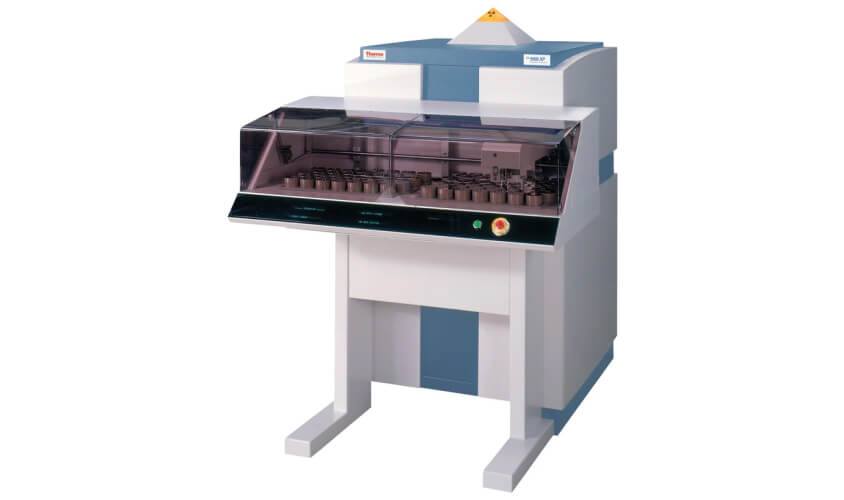
XRF lab instruments
Laboratory-based XRF systems can evaluate all kinds of materials and sample types. These instruments are used in analytical laboratories for applications as diverse as cement manufacturing, metallurgy, mining, geology and geochemistry, p...
Read more
XRF portable instruments
Portable XRF analyzers have become the standard for non-destructive elemental analysis in a wide range of applications. They are routinely used for rapid quality control inspection and analysis in order to ensure product chemistry specif...
Read more
Automation for XRF
Your XRF analysis can be facilitated using some of the Thermo Scientific automation solutions, which provide continuous and unattended operation, aid steel production, or provide a complete laboratory workflow automation solution. ...
Read more
FAQ - X-Ray Fluorescence (XRF)
An XRF spectrometer exposes a sample to primary X-rays, causing elements to emit characteristic fluorescent X-rays. The energy or wavelength of the emitted radiation enables elemental identification, while its intensity provides the basis for quantitative analysis.
EDXRF separates characteristic X-rays by energy, enabling rapid multi-element measurements. WDXRF uses diffraction by analyzing crystals to separate X-rays according to wavelength, providing higher spectral resolution. The choice depends on precision requirements, detection limits, and sample types.
XRF can analyze metals, alloys, ores, minerals, cement, ceramics, glass, polymers, and other materials. With suitable equipment, it can analyze solids, powders, pressed pellets, fused beads, and certain liquids. Sample preparation depends on the matrix and required accuracy.
Pressed pellets are produced by compressing finely ground samples, while fused beads are prepared by melting samples with a suitable flux. Fused beads generally provide better homogenization and reduced mineralogical effects, while pellet pressing is a simpler and faster procedure with less sample dilution.
Portable XRF analyzers are used for rapid alloy identification, raw material inspection, industrial material testing, and field measurements. They enable elemental composition analysis without transporting samples to a laboratory. Their capabilities depend on instrument configuration and target elements.
XRF accuracy is influenced by sample homogeneity, particle size, surface characteristics, sample thickness, and matrix effects. Calibration quality, suitable reference materials, and appropriate corrections for inter-element effects are also important.
Yes, certain XRF systems use standardless or fundamental parameter-based approaches to estimate the elemental composition of unknown materials. These methods are useful for screening and characterization, while demanding quantitative applications benefit from verification using appropriate reference materials.
XRF determines major and minor element concentrations in raw materials, clinker, cement, and mineral products, often reported as oxide composition. The analysis supports process control, product quality verification, and compliance with chemical specifications.
XRF has limitations when measuring very light elements because their characteristic X-rays have low energies and are easily absorbed. Analytical capabilities depend on the detector, X-ray tube, optics, and measurement atmosphere. Very light elements such as hydrogen cannot be determined using conventional XRF systems.
Automated XRF systems can integrate sample transport, preparation, analysis, and data processing into a single workflow. This increases sample throughput, improves reproducibility, and reduces manual intervention. They are particularly useful in metallurgy, mining, and cement production.