


Inductively Coupled Plasma Mass Spectroscopy (ICP-MS)
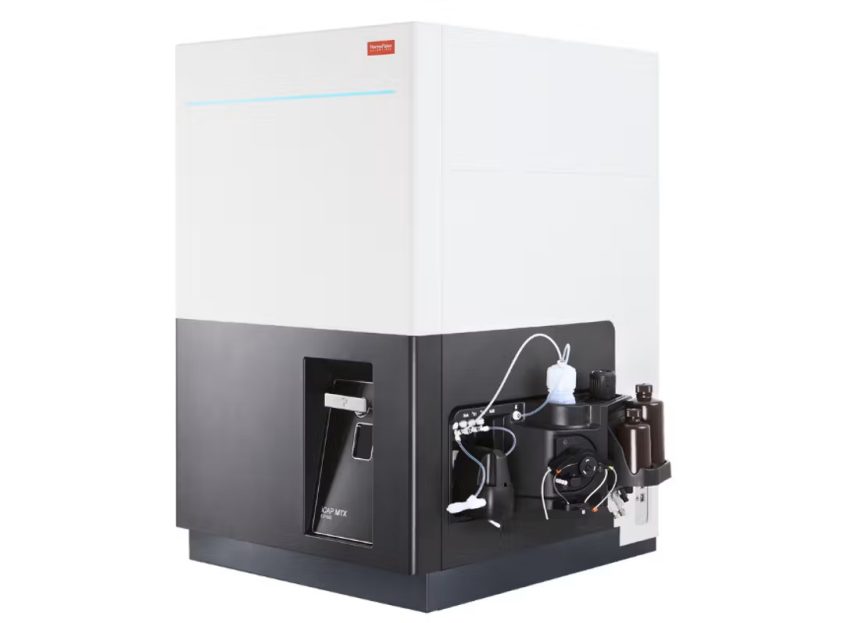
High Resolution Inductively Coupled Plasma Mass Spectrometry (HR-ICP-MS)
High-Resolution ICP-MS offers the most flexible and reliable analyses, for the best analytical results. It enables performing accurate and reliable quantitative multi-element analyses at trace level, with the highest sensitivity and with...
Read more
Single Quadrupole Inductively Coupled Plasma Mass Spectrometry (SQ-ICP-MS)
The Thermo Scientific iCAP RQ ICP-MS is suitable for a complete multi-element analysis solution for a high-throughput routine lab. With comprehensive interference removal for assured data accuracy and intuitive workflows that boost produ...
Read more
Triple Quadrupole Inductively Coupled Plasma Mass Spectrometry (TQ-ICP-MS)
Thermo Scientifictriple quadrupole ICP-MS systems ensure that your laboratory can meet evolving legislation requirements, enable exploring developing markets, and push the boundaries of your research. Whether seeking better data qualit...
Read more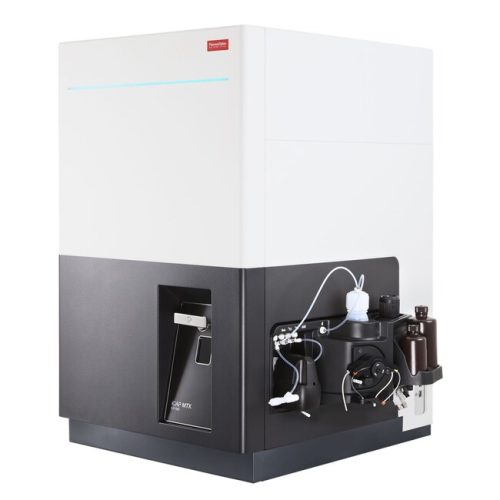
Multicollector ICP-MS
The Thermo Scientific multicollector ICP-MS systems meet demands for precise isotope ratio measurements owing to extraordinary precision, sensitivity, dynamic range and stability. These systems represent a grand step forward in multicoll...
Read more
FAQ - Inductively Coupled Plasma Mass Spectroscopy (ICP-MS)
ICP-MS uses inductively coupled plasma to ionize elements from a sample. The resulting ions enter a mass spectrometer, where they are separated according to their mass-to-charge ratios. The technique’s high sensitivity enables the determination of elements at extremely low concentrations.
Single quadrupole ICP-MS uses one mass analyzer to separate and detect ions. Triple quadrupole systems use two mass filters with a collision/reaction cell between them, enabling more effective control of certain spectral interferences and improved selectivity in complex matrices.
Collision and reaction cells use suitable gases to reduce spectral interferences. A collision gas, commonly helium, helps discriminate certain polyatomic ions through collisions, while reaction gases can chemically transform interfering or target ions to achieve more selective measurements.
High-resolution ICP-MS (HR-ICP-MS) can separate ions with very similar mass-to-charge ratios due to its high mass resolution. It is used for demanding Thermo Scientific™ trace™ element analysis in geology, materials science, environmental testing, and other applications where spectral interferences limit analytical performance.
Multi-collector ICP-MS (MC-ICP-MS) enables simultaneous measurement of multiple isotope beams with very high isotope ratio precision. It is used in geology, geochronology, nuclear research, and isotope geochemistry, as well as studies of elemental origin and transport.
ICP-MS can achieve detection limits at ppb (µg/L), ppt (ng/L), and, for selected elements under optimized conditions, even lower levels. Actual detection limits depend on the element, reagent purity, sample matrix, instrument configuration, and contamination during sample preparation.
ICP-MS enables the determination of very low concentrations of potentially toxic elements such as arsenic, cadmium, mercury, and lead. It supports elemental impurity testing under ICH Q3D and relevant pharmacopoeial procedures. The method must be appropriately developed and validated for the specific sample type.
Because ICP-MS can detect extremely low concentrations, even small amounts of contamination from laboratory vessels, reagents, or the environment can significantly affect results. High-purity reagents, suitable containers, procedural blanks, and carefully controlled sample preparation are recommended.
Internal standards are used to monitor and correct signal variations caused by instrumental drift and certain matrix effects. Known concentrations of selected elements, which are not expected to be present at significant levels in the sample, are added to samples and calibration solutions.
Productivity can be improved through automated sampling, optimized rinse times, appropriate method selection, and automated data processing. A balance must be maintained between analysis speed, instrument stability, interference control, and required detection limits.